
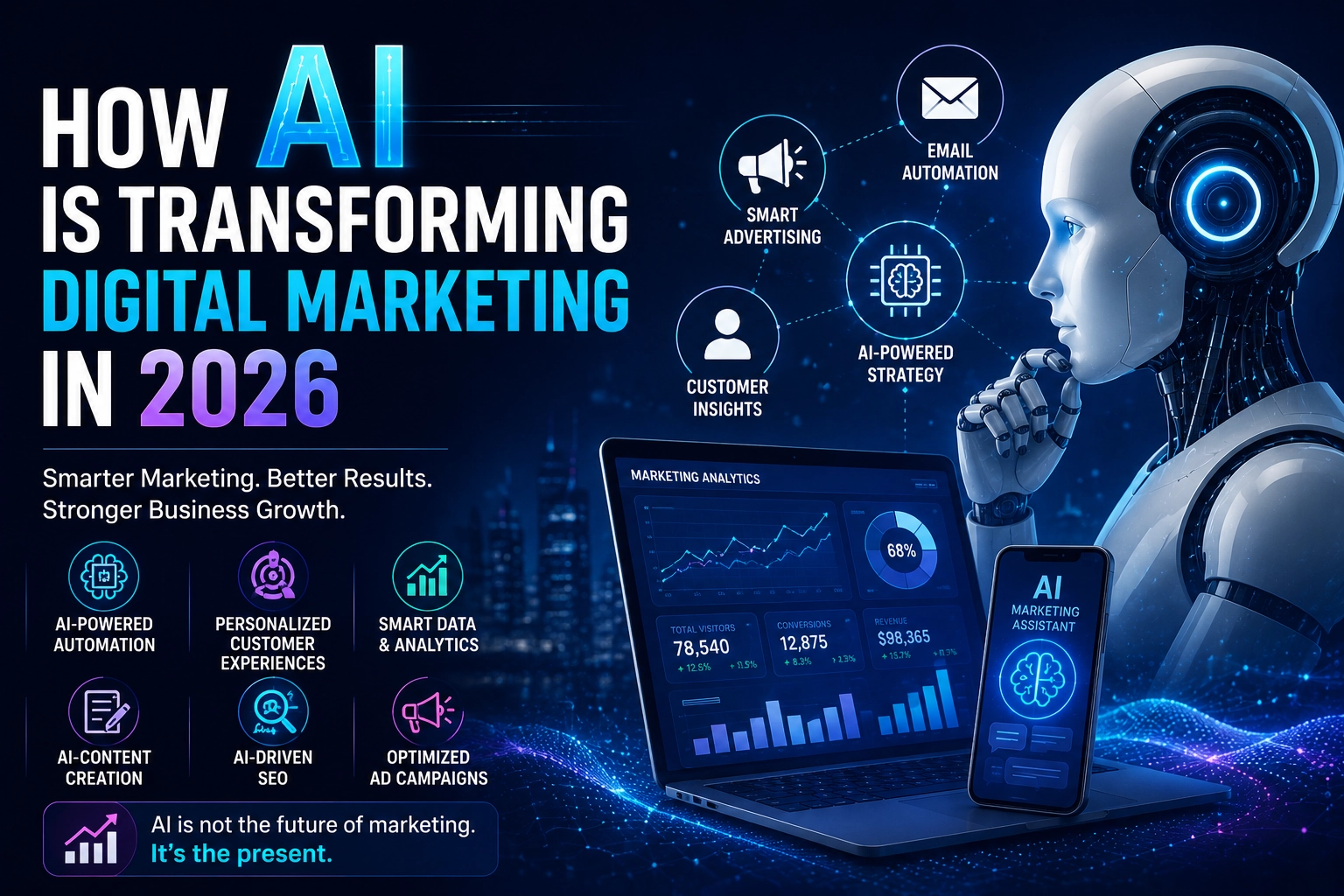
The digital marketing landscape is evolving faster than ever, and Artificial Intelligence (AI) is leading the transformation. What once seemed like a futuristic concept has now become an essential tool for businesses looking to improve marketing performance, increase efficiency, and deliver personalized customer experiences.
Across Australia, businesses of all sizes are adopting AI-powered solutions to streamline their marketing efforts and gain a competitive advantage. From content creation and customer service to data analysis and advertising optimization, AI is helping marketers achieve better results with less time and effort.
In this article, we’ll explore how AI is transforming digital marketing in 2026 and why businesses should embrace this technology to stay ahead of the competition.
What is AI in Digital Marketing?
Artificial Intelligence refers to technology that can perform tasks requiring human intelligence, such as learning, analyzing data, making decisions, and generating content. In digital marketing, AI helps businesses automate processes, understand customer behavior, and create more effective marketing campaigns.
AI-powered tools can analyze large amounts of data within seconds, providing valuable insights that would take humans hours or even days to uncover.
The Growing Importance of AI in Marketing
Modern consumers expect personalized experiences, instant responses, and relevant content. Meeting these expectations manually can be challenging, especially for growing businesses.
AI enables marketers to:
- Understand customer preferences
- Create personalized marketing campaigns
- Improve customer engagement
- Automate repetitive tasks
- Increase return on investment (ROI)
As competition continues to increase online, businesses that leverage AI are often able to outperform those relying solely on traditional marketing methods.
1. AI-Powered Content Creation
Content remains one of the most important aspects of digital marketing. However, consistently creating high-quality content can be time-consuming.
AI tools now help marketers generate:
- Blog posts
- Social media captions
- Email campaigns
- Product descriptions
- Advertising copy
These tools can assist with brainstorming ideas, improving content quality, and optimizing content for search engines.
While human creativity remains essential, AI significantly reduces the time required to produce engaging content, allowing businesses to focus on strategy and growth.
2. Personalized Customer Experiences
Personalization has become a key factor in successful marketing campaigns.
AI analyzes customer behavior, browsing history, purchase patterns, and engagement data to create highly personalized experiences. Instead of showing the same message to every customer, businesses can deliver content that matches individual interests and preferences.
Examples include:
- Personalized email recommendations
- Customized website experiences
- Product suggestions based on previous purchases
- Targeted advertising campaigns
This level of personalization increases customer satisfaction and often leads to higher conversion rates.
3. Smarter Advertising Campaigns
Online advertising is becoming increasingly competitive. AI helps businesses maximize their advertising budgets by improving targeting and campaign performance.
AI-powered advertising platforms can:
- Identify ideal audiences
- Optimize bidding strategies
- Predict customer behavior
- Improve ad placements
- Analyze campaign performance in real-time
This allows marketers to make data-driven decisions and achieve better results from platforms such as Google Ads, Facebook Ads, and LinkedIn Ads.
Businesses using AI-driven advertising often experience improved click-through rates, lower acquisition costs, and higher returns on their marketing investment.
4. Enhanced Customer Support with AI Chatbots
Customer service plays a major role in business success. AI-powered chatbots have become an effective solution for providing instant support and improving customer experiences.
Modern chatbots can:
- Answer common questions
- Assist customers 24/7
- Schedule appointments
- Recommend products and services
- Guide users through the buying process
By automating routine interactions, businesses can reduce support costs while maintaining high levels of customer satisfaction.
Customers appreciate quick responses, and AI chatbots help ensure that inquiries are addressed without delay.
5. Advanced Data Analysis and Insights
One of AI’s greatest strengths is its ability to process and analyze large amounts of data.
Digital marketers collect information from multiple sources, including websites, social media platforms, advertising campaigns, and customer databases. AI can identify trends, patterns, and opportunities that may otherwise go unnoticed.
With AI-powered analytics, businesses can:
- Understand customer behavior
- Predict future trends
- Identify high-performing campaigns
- Improve decision-making
- Measure marketing effectiveness
This data-driven approach enables businesses to make smarter marketing investments and achieve better outcomes.
6. Better SEO and Search Visibility
Search Engine Optimization (SEO) remains a crucial component of digital marketing.
AI tools help marketers improve SEO by:
- Identifying valuable keywords
- Analyzing competitor strategies
- Optimizing website content
- Improving user experience
- Monitoring search performance
Additionally, search engines themselves are increasingly using AI to understand user intent and deliver more relevant results.
Businesses that incorporate AI into their SEO strategies can improve search rankings and attract more organic traffic.
Challenges of Using AI in Marketing
While AI offers many benefits, businesses should also be aware of potential challenges.
Some common concerns include:
- Over-reliance on automation
- Data privacy and security issues
- Maintaining authentic brand voice
- Need for human oversight
AI should be viewed as a tool that enhances human capabilities rather than replacing human expertise entirely.
The most successful marketing strategies combine AI efficiency with human creativity and strategic thinking.
The Future of AI in Digital Marketing
AI technology continues to advance rapidly, and its role in digital marketing will only become more significant.
Future developments are expected to include:
- More advanced personalization
- Improved predictive analytics
- AI-generated video content
- Enhanced voice search optimization
- Greater automation of marketing workflows
Businesses that adopt AI early will be better positioned to adapt to changing consumer expectations and market conditions.
Conclusion
Artificial Intelligence is revolutionizing digital marketing by helping businesses create better content, improve customer experiences, optimize advertising campaigns, and make smarter decisions through data analysis.
As we move further into 2026, AI is no longer a luxury—it’s becoming a necessity for businesses that want to remain competitive in the digital world.
Companies that embrace AI-driven marketing strategies today can increase efficiency, drive more conversions, and build stronger relationships with their customers. By combining AI technology with human expertise, businesses can unlock new opportunities for growth and long-term success.